
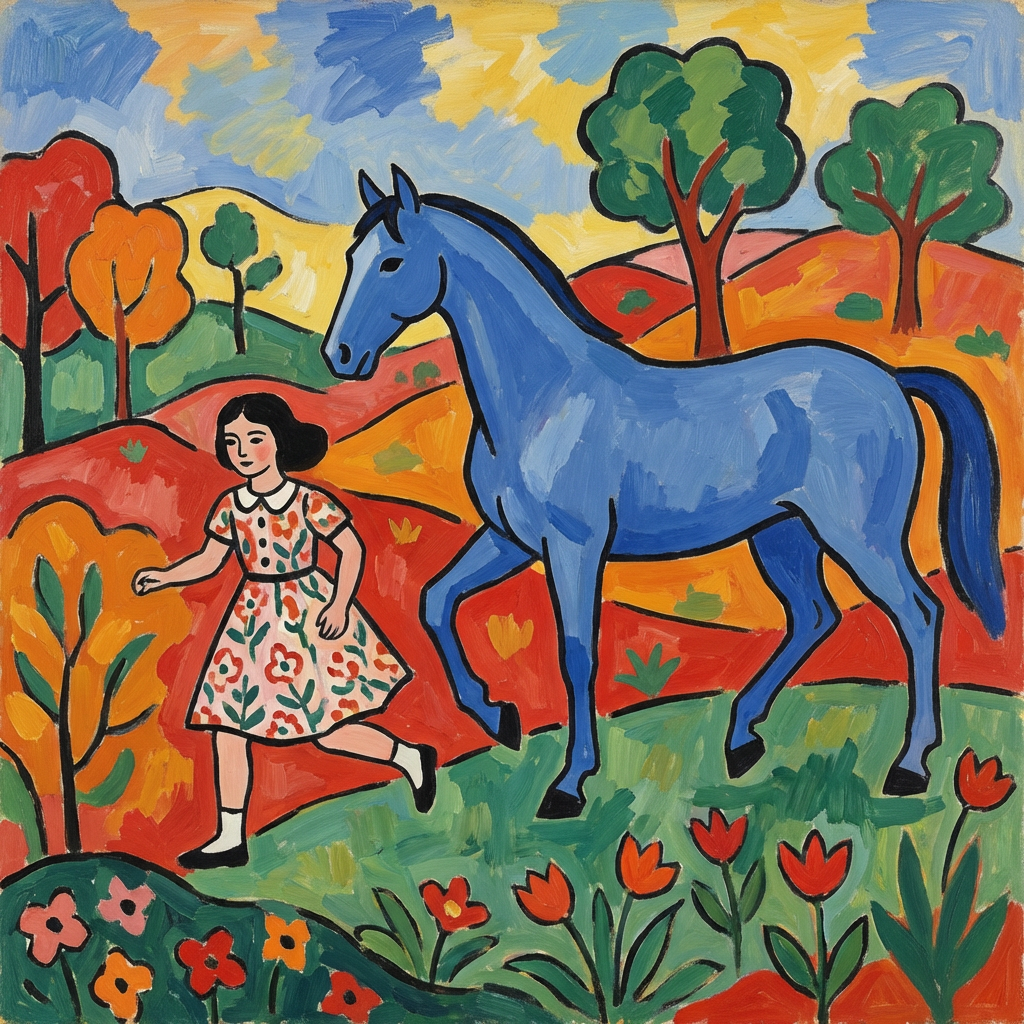
The girl at the blackberry fence feeds the horses long grass from the pasture. A wife sweats as she makes bread in a kitchen a way off. Children in a dusty yard believe their father hung the moon. The tractor stops, and his sudden plunge spills her fear. The girl fights oily hands, her mouth—stuffed too full to scream. A running girl frightens the herd, and beautiful horses kick in wild circles. A girl running with horses, seen through a kitchen window, startles. The discovery is quickly buried and never spoken.
First collected in Eating the Heart First, Press 53
Nacona
The low sun burns the dying grass to gold. I’m just barely holding, not at all gripping, the leather reins in my hands. I squeeze my thighs tightly and jut my boot heels downward and outward to tighten my seat in the saddle. We walk. She follows the fence, stopping to taste the grass, but I pull her head up, jerking lightly on the reins to let her know that she must not stop. I have encouraged this bad habit, stopping to let her graze while I ride on slow summer days. I am a poor teacher. I lack foresight and follow-through. I have never shown her who the boss is.
Nacona is the reason I dream of horses. She was a gift to me, a horse-loving girl’s dream made real. I begged for her. I never thought my begging would gain me any favor, but my father had a giving heart and acquiesced. I had to be educated in horse care and also prove that I could do what needed to be done.
My home was walking distance from my high school, but rather than walk home every day after school, after I had Nacona, I rode school bus No. 33 as far as it went. I got off at the last bus stop, the closest one to the horse stable at which we boarded Nacona. I had to cross a five-lane highway and walk through a puzzle of a trailer park— I had to walk at least a mile and three-quarters to get from that last stop to the stable.
We chose this dilapidated horse barn for its proximity to our home, its low rent, and its amenities: a 40-acre pasture and a few short riding trails. Every afternoon, I would call Nacona in from the pasture with a whistle and a handful of hay. She’d slowly mosey over and nuzzle me. Every afternoon after I rode her, or walked her for exercise, I’d take her in the stable barn, tend to minor wounds, brush her coat, detangle her mane, and scrape clean her hooves. After she’d cooled down, I’d put her in her stall and feed her a bucket of sweet feed. My father paid another horse owner to feed her mornings and turn her out in the pasture for the day. On Saturday and Sunday, my father would drop me off early in the morning so I could spend the whole day at the stable. A hundred times, I mucked out the stall of horse shit, wet, rotting hay, and piss-clotted rice chaff.
The too-tight, frayed cut-offs I am wearing bite and cut high on my thigh. Wearing them was a dumb idea. The saddle is rough, tugs against my bare skin. But when I run my hands over it, after rubbing it for a solid hour with saddle soap and buffing it to a gloss, it feels like smooth, warm plastic. This was a used saddle my father bought out of a garage for $100. It was a bit marred, and now the rough bits, nubs of scarred leather, and the scroll of leaves embossed on it make my skin pain-tender. It hurts so much that I feel I cannot chance a gallop. I think I am blistered, at least raw, and surely blemished. I dismount and walk Nacona back to the barn. Outside of the barn, there is a concrete slab and a pipe rail next to the water hose. I clip the lead onto her halter and remove her bridle. I remove the saddle and slide off her blanket. I tie the lead rope to the pipe and turn the hose on myself. I let the icy water run slowly on my thighs and yelp in cold pain. I am careful not to get Nacona wet. She did not sweat, and it will be colder tonight. It is near dusk now, and soon Daddy will rumble up the gravel road in his station wagon to pick me up.
I named Nacona after a pair of cowboy boots, but I spelled the name wrong. The boot company took its name from Nocona, Texas, which was named for Peta Nocona, a Comanche chief. Nacona was gentle, passive, slow, and fat. She was six years old when we bought her and had never been ridden. She accepted the saddle easily. I had to teach her to follow my direction by “mule reining” or “plow reining,” by pulling the right rein when I wanted her to turn right and the left when I wanted to go left, like flipping a car’s turn signal. When I would pull the rein, I would also touch the opposite rein on her neck to teach her how to neck rein. I knew as little about horseback riding as that old mare. When we were getting the hang of it all,
The drainage ditch is wide and full of water. Nacona heaves over it because I ask her to. We slide three feet in the mud. Nacona’s back legs give out, and she rolls me off. My feet dangle out of the stirrups, and I sloppily rise unbroken but soaking with mud. Monica is riding her Thoroughbred gelding, Lucky, and she turns back to laugh at me. I burn with humiliation. I scoop a patty of mud with both hands and hurl it at her. Lucky half-rears and breaks into a sideways gallop. Monica stops Lucky and hops off his back. She trudges through the field, wildly threatening me. I cup another whopping pound of mud and throw it smack dab in her face. Her mouth is open, blurting a curse, and now she’s choking out black mud. Her choking turns to laughter, and she fills her hands with a solid mud bomb. It hits me in the right boob. That’s it. Our mud fight’s a free-for-all. We pound each other with mud loaves, smear mud in our hair, pack mud on our bellies, stuff our pockets with stinking mud, and wade knee-deep in it.
The horses are loose; a bit confused but settle away from the ruckus. We’re sopping from head to toe. We’re rolling in the mud. Burbling laughter thickens the air, and night drops. We’re wearing heavy blankets of mud, dancing in the light of a half-moon. A white blob bobs in the distance. It is Comet, the albino pony that always hangs around the stable barn door. Comet’s owner, Rachel, rarely checks on her horse. Comet has a fat grass belly that makes him look like a pregnant mare. Monica and I, and one or two of the other horse owners, take pity on the pony and give him feed from our own barrels. But mostly, the horse owners are aloof; they bitch and scorn Rachel’s neglect of Comet but do nothing about it. We follow Comet’s beam in the moonlight and navigate zigzag back to the barn. We hose each other off; at first, it is a continuation of fun, but the water’s freezing, and the air’s relentlessly cold. Nacona and Lucky walk up to the stable barn doors. Their saddles are hanging, nearly falling off. I squeeze mud and water out of my hair. I am shaking in spasms from the cold.
The day Nacona died, I was told by the school secretary not to ride bus No. 33. I asked what was wrong. She said my mother had forgotten about a doctor’s check-up I had that afternoon, so I needed to go directly home. When I arrived at home, my mother was waiting in the kitchen. She had a weird smile on her face when she told me Nacona was dead. It was the weirdest thing—that smile. She wore it so well, like she’d rehearsed it for hours. I can only surmise that it was her nervousness, or perhaps she was trying to keep me from reacting badly by smiling as a way to assure me “that all will be better.” Her smile made me angry. It was a put-on, false, and I needed authenticity. I needed hardness to make it real, because seeing her smile, I did not believe what she was saying. Her smiling face didn’t fit with the words that were coming out of her mouth. The smile was a lie overlaid on a bigger lie.
Nacona was not dead. I wanted to go to the stable and see her. My mother absolutely refused.
I called Monica. She already knew. She had gone after school to tend to Lucky and saw the carcass with her own eyes. I never did. I had to rely on second-hand accounts of what my horse looked like and how she met her end. No one wanted to tell me. I had to beg for information, and yes, the gory details. I wanted the descriptions, the most vivid images to fill my head with pictures, sounds, and the blood of the real. I was told that putting her to sleep was the right thing to do because the treatment for colic had not worked. I was told that when she was put up in her stall, she was so wild with pain she knocked herself out, beating her head against the wooden beams. I was told it was bad. It was so bad that there was nothing else to do but put her out of her misery. It happened so fast. I wish I had been allowed to be with her when the vet put her down. Why couldn’t I be called out of school? Couldn’t the vet have come after 3 PM?
My mother assumed I couldn’t handle Nacona’s dying. She decided I should be removed from the entire process. She over-protected me in that instance and others. I think seeing Nacona’s death or her remains would have opened me to grieve and accept the loss. I was told that the stable owners contracted a backhoe operator to dig the hole to bury Nacona. From what I was told, it was a week before the operator could make it to the stable property because he was backlogged and burying a dead horse was neither a high priority nor a money-making proposition for him. Every day that week, I checked with Monica to see if Nacona had been buried, and every day she was still above ground, I begged my mother to let me see my horse. I didn’t care that she was decomposing. I wanted to see her. To say goodbye to whatever form was left.
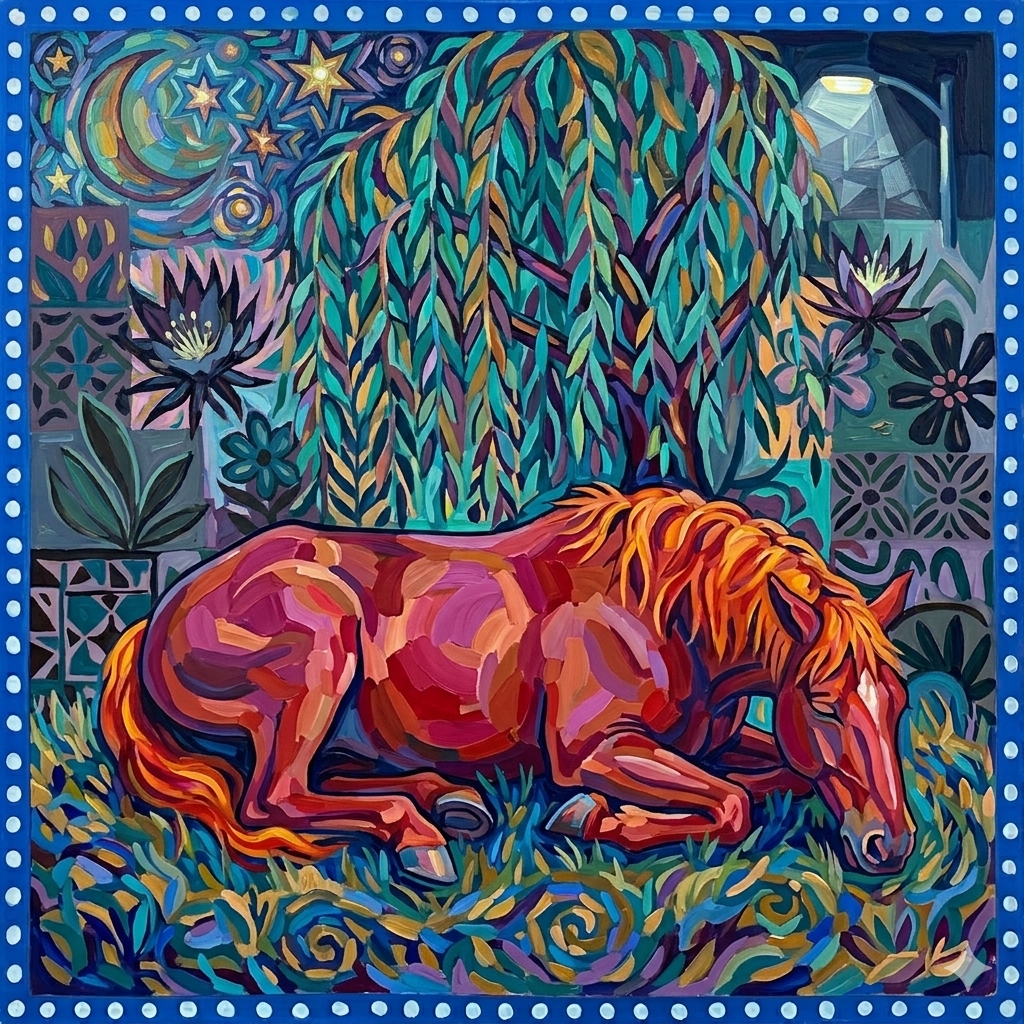
Nacona is graying. Her open eyes are moonish, staring into the hills of clouds. She’s rolling, without moving, bloated and twisted under a tall, leafless pear tree. Her legs are stiff in the air, and her tongue is drooping. There are thick patches of green clover lolling under and around her. Flies drift like a curtain of black lace.
How is it that what I never saw is yet a still-burning fire in my mind?
(c) 2026 Clare L. Martin
